Type in what you think is the domain name for Google into your
browser. I bet you typed www.google.com, or for the no-www folks,
google.com.
The correct answer, as far as I know, should be www.google.com.,
though (or google.com.) – the difference being the terminal dot at
the end. According to RFC 1035,
an “absolute” domain name (also later referred to as a Fully Qualified
Domain Name) should have a terminal dot, in order to prevent path spoofing.
RFC 1738,
which defines a Common Internet Scheme Syntax, explicitly says that the “host” portion of a
URL should be an FQDN. From what I understand (and after confirming
with some light testing), most stub resolvers will basically interpret
any domain with a dot (not just a trailing one) as an FQDN. This
seems to work fine in most cases.
Background: I stumbled across this while casually putting a
trailing dot at the end of some random sites to see if resolution
works for them. There are interesting results when this interacts with
SSL certs, or
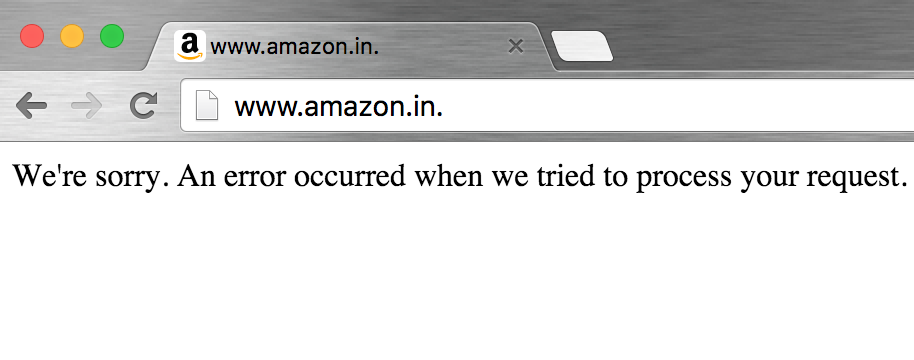
with CDNs like CloudFront. I was somewhat surprised to see that Amazon
India, for example, does not seem to resolve properly for either
www.amazon.in. or amazon.in.. I don’t imagine this impacts too
many people though.
My website handles trailing dots just fine.